Design Services
Drone Platform
Engineering
From mission requirement to integrated system — airframe, payload, power, RF, and electronics designed together.
Our approach
We don't build frames.
We engineer drone platforms.
The difference is systems thinking. Every discipline — structure, power, RF, payload, avionics — resolved as one integrated machine, not assembled from whoever's catalogue was closest.
Custom Payload & Rail Integration
Your payload defines the aircraft. We design the mechanical interface first — mounting rails, locking geometry, vibration isolation, and cable management — then build the airframe around it. The result is a system where payload access is deliberate, swaps are repeatable, and nothing is improvised.
Electrical Connector & Interface Design
Every connection on a drone is a liability waiting to fail. We specify connectors for the environment — vibration rating, ingress protection, mating geometry, and retention — then route harnesses as part of the structural layout, not over the top of it. Where off-the-shelf hardware won't close the design, we design custom PCB solutions with the embedded logic to match.
Antenna Optimisation
Antenna placement is fundamentally a packaging decision, and most platforms make it last. We treat RF as a first-order design input — link budget, placement for minimal airframe obscuration, cosite interference management across control, video, and navigation bands. Antennas end up where the physics demands, not where there's space left over.
Full Platform Architecture
We design the whole machine. Frame geometry, power topology, comms architecture, payload envelope, thermal management, and ground system integration resolved together — not handed off between disciplines. We write the requirements, own the trade-offs, and deliver a coherent integrated platform. Not a collection of compatible components.
Design for Additive Manufacturing
Additive manufacturing unlocks geometry that other methods can't produce — but only if the design was written for it. We work from material behaviour up: print orientation for structural load paths, multi-material strategy where stiffness and compliance need to coexist, and post-processing built into the design intent. Tolerances are resolved in the model, not discovered on the build plate.
Avionics & Electronics Integration
Flight controllers, ESCs, sensor fusion, and firmware — handled as part of the platform design, not bolted on at the end. We close the loop between airframe and avionics: thermal management through the electronics bay, stack constraints resolved in the chassis geometry, and custom electronics where the mission demands it. The hardware and the software are one design problem.
See the work
Want to see how we work?
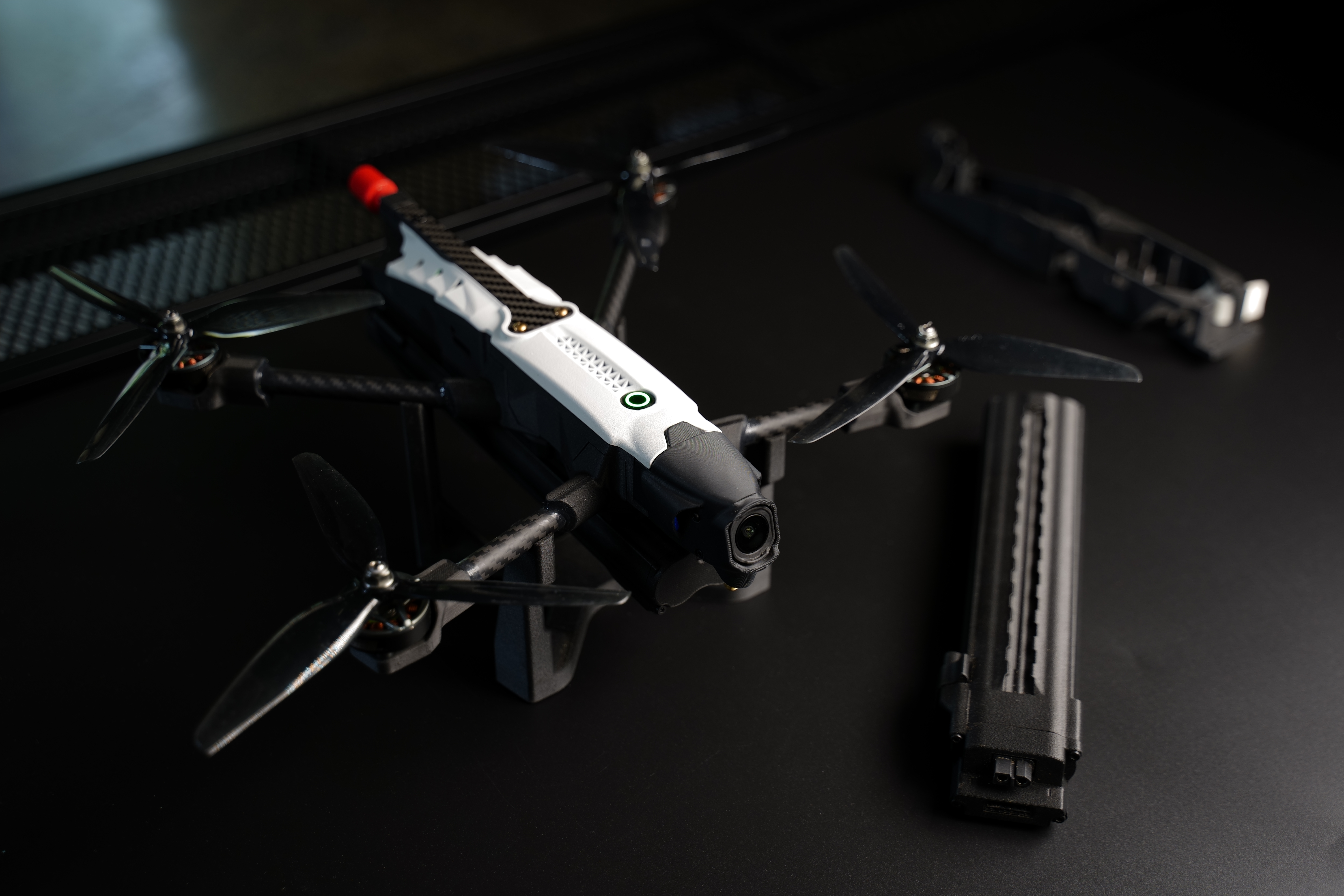
The Replicant GEN 1 is built on these principles and fully documented — architecture, BOM, CAD, and flight data, openly available.
How we engage
From brief to handoff
Brief
Mission requirements, payload specs, regulatory context, and operational envelope. We listen before we draw.
Concept
Architecture trade study, geometry options, and interface definition. Trade-offs documented, nothing assumed.
Detailed Design
CAD, electrical schematics, connector specs, BOM, and DFM review. Every decision traceable to a requirement.
Prototype & Test
We build and fly what we design. Real-world iteration, not simulated confidence.
Handoff
Full documentation package — CAD, BOM, build guide, manufacturing files. The design is yours to own.
Why Yirra
Engineering depth.
Not engineering theatre.
We engage with the hard parts of the design — the constraints that don't fit in a requirements doc, the integration problems that only surface under load, and the operational realities that a design studio won't know to ask about.
We fly what we build
These aren't design capabilities assembled for a pitch deck. We operate the systems we engineer in real conditions, which means we understand failure modes, operational friction, and what actually matters in the field — before it matters to you.
AM-native, not AM-converted
We've designed for additive manufacturing from the ground up, not adapted CNC thinking to a new process. That distinction shows in every geometry decision: structure placed where loads are, material strategy chosen for the environment, and manufacturing constraints treated as design inputs from day one.
Proven, public reference architecture
The Replicant GEN 1 platform is openly documented at docs.yirrasystems.com — architecture, BOM, CAD, and flight data. That's the foundation every engagement builds on. You can read it before you call us.
Reference work
The kind of problems we solve
Specific case studies are available under NDA. These are representative engagement types.
Research Institution
Atmospheric sensing payload integration
Custom rail interface designed around a 400g sensor package with vibration isolation and hot-swap capability. Delivered architecture, CAD, and DXF files for in-house fabrication.
Commercial Operator
Long-range RF link optimisation
Antenna placement redesign for a multi-band system (control, video, nav) on an existing platform. Resolved cosite interference that was causing video dropout at range.
OEM Partner
Full platform architecture from requirements
End-to-end design for a purpose-built long-range platform: requirements analysis, geometry trade study, integrated BOM, CAD, and first-article build and test.
Scope & pricing
What to expect
We work on a project basis, retainer, or technology partnership — depending on the scope and stage of your program.
Targeted subsystem engagements (antenna optimisation, payload interface design) typically run over 2–6 weeks. Full platform programs from requirements to handoff are longer-horizon commitments.
All engagements start with a no-cost scoping call. If the fit is right, we'll scope the work and agree on a fixed-price or milestone-based structure before anything starts.
Book a discovery call
30 minutes. No obligation. Tell us what you're building and we'll tell you how we'd approach it — and whether we're the right fit.
Book a discovery callor email [email protected]Ready to engineer something serious?
Tell us about your mission. We'll tell you how we'd approach it.